 Sound Wood
Worked example: a blackgum with a basal cavity
It's one thing to explain how sonic testing works and another to see it applied to a real tree. This post walks through a test on a blackgum (Nyssa sylvatica) with an open cavity at the base, step by step, from setup to the words you'd put in a report.
About this example: the tree and photo are real, from a field visit. The readings below are an example set prepared to match what's visible at the cavity, so they show the method clearly. They are not presented as the measured results of that visit.
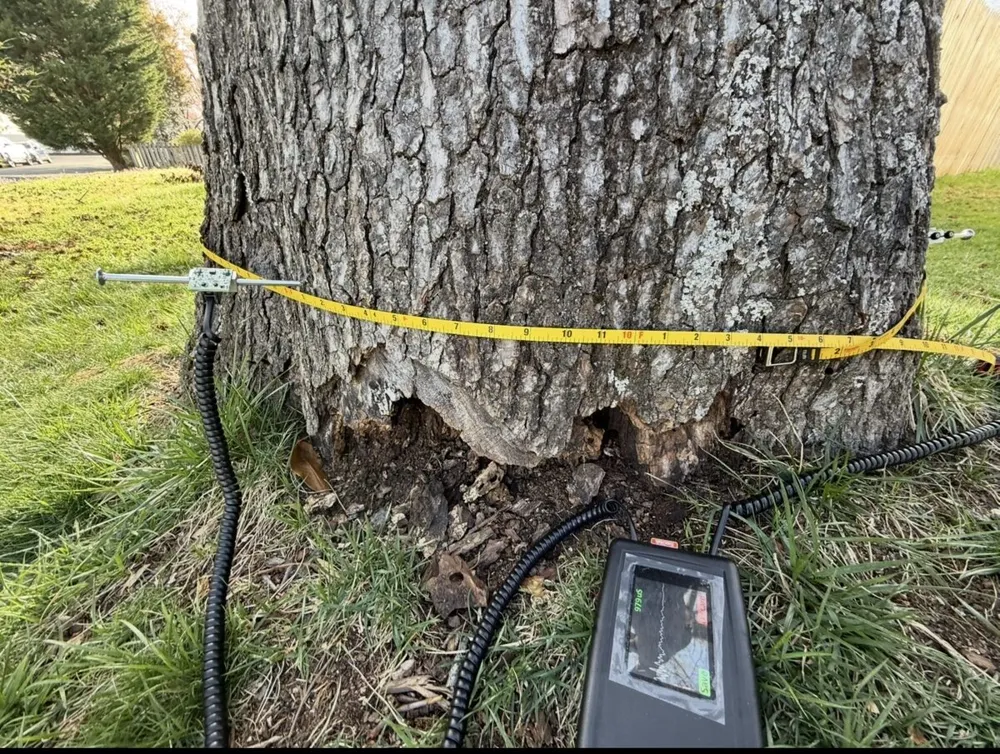
The tree and the question
A front-yard blackgum. From the outside, the obvious defect is an open cavity at the base with soft, dark, decayed wood visible inside and crumbled debris on the ground. For the example, the trunk is taken as 96 inches in circumference at the test height.
The question a client would ask: how far does that cavity go into the trunk, and is the rest of the base sound? You can see the opening; you can't see how far it runs inside.
Setup
- Species: blackgum, a hardwood, so the cutoff is 22 µs per inch.
- Height: just above the cavity, as low as consistent contact allowed, with the tape run level around the trunk.
- Positions: 7, spread around the trunk at 3, 17, 31, 44.5, 58, 72 and 85.5 inches from the zero mark. One position, S4, was placed close to the cavity on purpose, to see whether the decay reaches the bark there.
- Direction: S4 faces north, so the map's north arrow lines up with the cavity side.
- Pairs: all 21 pairs of the 7 positions, so paths cross the trunk from every direction.
The readings
With a two-sensor detector, each pair is a separate set of taps: put the sensors on the two nails, tap, check the readings are consistent, save, and move on. Each time goes into the app as one row.
The pattern in the example readings:
- Paths between positions away from the cavity, such as S1 to S2 or S5 to S6, are well under the cutoff. Green.
- Every path that uses S4 is slow, some of them far above 22 µs per inch.
- Paths that cross the trunk toward the north side are slow too, while paths staying on the south side are sound.
Because every path from S4 is slow, the first thing to rule out is contact. Sound Wood's reading checks point this out, and the right response is to reset the nail and re-test a couple of S4's paths. Here, with an open cavity right next to S4, slow paths are exactly what you'd expect.
The decay map
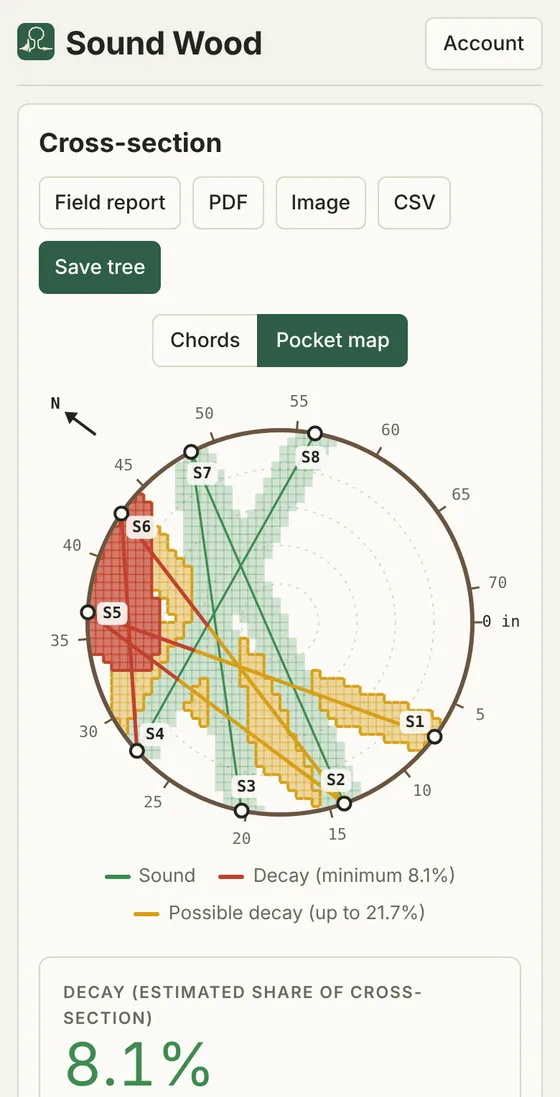
The slow paths through S4 cross each other with no sound path between them, so the area near S4 is confirmed red. Because all the paths at S4 are slow and no central pocket explains them, the app treats the decay as reaching the bark at S4, which matches the open cavity. The pocket map shows one pocket on the north side running out to the bark.
The result in the example: Decay (minimum about 11%), Possible decay (up to about 18%). The difference is a band of yellow along slow paths next to the confirmed pocket, where no second slow path crosses to confirm it.
Reading it
- Where: the decay is on one side, the north, and open to the bark at the cavity.
- How much: about a ninth of the cross-section is confirmed, possibly closer to a fifth.
- The rest: the south side shows sound paths crossing, so there's a sound section of trunk opposite the cavity.
- What the map can't say: whether the decay is spreading, how far up or down it runs, and what's happening in the roots under the cavity.
Decay that's open to the bark on one side is a different situation from the same amount of decay enclosed in a sound shell, because the shell isn't continuous. That's a judgment call for the arborist, taking in the crown, the lean, which way the load falls, and what's underneath.
How it might read in a report
"Sonic decay testing at the base, just above the cavity, found confirmed decay in about 11% of the cross-section, possibly up to 18%, on the north side, reaching the bark at the cavity. The south side tested sound. Decay open to the bark on one side reduces the trunk's strength more than the same amount enclosed in sound wood. I recommend [your recommendation] and a re-test at the same height and positions in 12 months."
In Sound Wood, the field report puts the map, the range, the photos and your notes on one page with your name and business details, and Write it up can draft wording like this from the readings and notes for you to edit.
What this example shows
- Put a position next to the visible defect so you learn whether decay reaches the bark there.
- Take every pair so paths cross from all directions.
- When one position reads slow on every path, rule out contact before you call it decay.
- Report the range and where the decay is, not just a single percentage.